
Electric, Charcoal, Pellet, Gas, or Offset Explained
What is the best smoker for beginners?
The best smoker for beginners depends on how much time and effort you want to invest. Electric smokers are the easiest to use, pellet smokers offer a balance of convenience and smoke flavor, charcoal smokers teach traditional fire control, gas smokers provide quick operation, and offset smokers deliver the deepest smoke flavor but require the most skill.
Introduction
Choosing your first smoker is one of the most important decisions in BBQ. With so many options available, electric, charcoal, pellet, gas, and offset smokers, it is easy for beginners to feel overwhelmed.
Some smokers are designed to be simple and hands-off. Others require constant attention, fire management, and patience. None are wrong choices, but each fits a different lifestyle and learning curve.
The best smoker for you comes down to three factors:
- How much time you want to spend managing the fire
- How important deep smoke flavor is to you
- How much you want to invest in equipment and maintenance
This guide breaks down each smoker type so you can confidently choose the best starting point for your backyard BBQ journey.
Electric Smokers: The Easiest Starting Point
Why Beginners Like Them
Electric smokers are often recommended for first-time cooks because they remove most of the complexity. You plug them in, set the temperature, and let them run.
Pros
- Simple digital temperature controls
- Very consistent cooking temperatures
- Minimal fire management or babysitting
- Works well where charcoal or open flames are restricted
Cons
- Smoke flavor is lighter than wood or charcoal
- Requires access to electricity
- Can feel more like an oven with smoke
Best For
Beginners who want ease, predictability, and a low-stress introduction to smoking.
Charcoal Smokers: The Traditional Learning Path
Why Beginners Struggle at First
Charcoal smokers demand more attention, but they reward patience with authentic smoke flavor.
Pros
- Bold smoke flavor using charcoal and wood chunks
- Affordable entry-level options available
- Teaches airflow, vent control, and fire management
- Skills transfer to almost any smoker type
Cons
- Temperature control takes practice
- More cleanup from ash
- Longer learning curve
Best For
Beginners who want to learn traditional pit skills and enjoy hands-on cooking.
Pellet Smokers: Balance of Convenience and Flavor
Why They Are So Popular
Pellet smokers bridge the gap between electric ease and charcoal flavor.
Pros
- Digital controllers keep steady temperatures
- Real hardwood pellets provide better smoke than electric or gas
- Push-button ignition and easy startup
- Many models also grill and roast
Cons
- Higher upfront cost than electric or basic charcoal
- Ongoing pellet expense
- Smoke flavor is milder than offsets or charcoal
Best For
Beginners who want convenience without sacrificing too much smoke flavor.
Gas Smokers: Fast and Practical
Why People Choose Them
Gas smokers operate similarly to gas grills, making them familiar and quick to use.
Pros
- Easy to operate
- Heats up quickly
- Widely available and affordable
- Less learning curve than charcoal
Cons
- Lighter smoke flavor
- Requires propane tanks
- Often smaller cooking capacity
Best For
Beginners who want straightforward smoking with minimal setup time.
Offset Smokers: The Traditional Texas Pit
Why They Are Legendary
Offset smokers, also known as stick burners, are the heart of traditional Texas BBQ. Fire is built in a side firebox and fed with wood splits.
Pros
- Deep, authentic smoke flavor
- Large cooking capacity
- Full control over fire and smoke
- Uses classic woods like post oak, mesquite, or pecan
Cons
- Steep learning curve
- Requires constant fire management
- Larger footprint and heavier construction
- Higher cost for quality models
Best For
Beginners who are serious about learning traditional BBQ and willing to invest time and effort.
Budget and Maintenance Considerations
Typical Price Ranges
- Entry-level: Electric or small charcoal smokers, $150 to $350
- Mid-range: Pellet or larger charcoal smokers, $400 to $800
- Premium: Offset smokers and high-end pellet grills, $800 to $2,000+
Maintenance Expectations
- Electric and pellet smokers need routine cleaning and part checks
- Charcoal and offset smokers require ash removal and firebox care
- Gas smokers need burner inspection and propane management
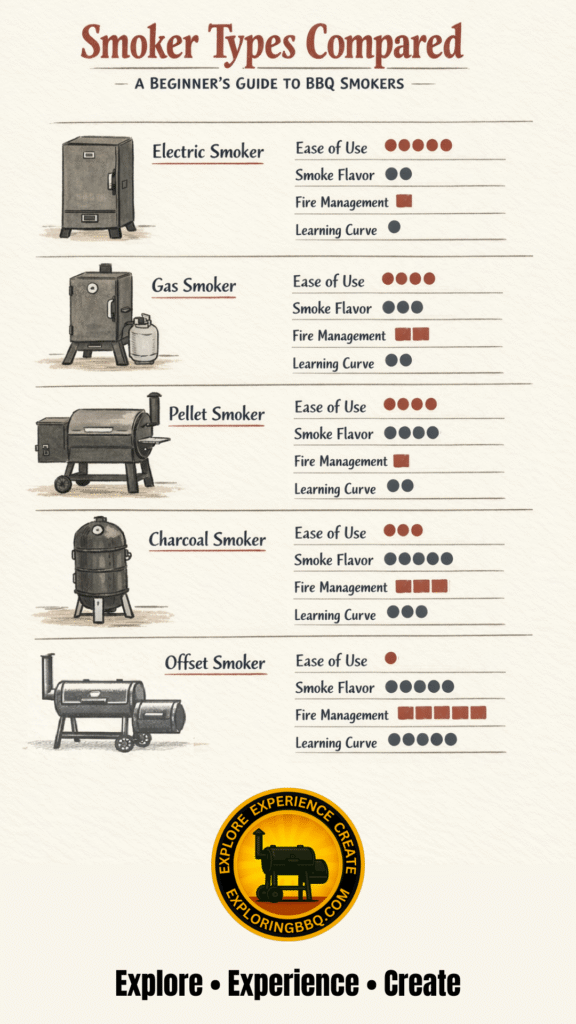
Smoker Decision Chart for Beginners
Use this chart to quickly compare smoker types based on effort, flavor, cost, and learning curve.
| Smoker Type | Ease of Use | Smoke Flavor | Fire Management | Typical Cost | Learning Curve | Best For |
|---|---|---|---|---|---|---|
| Electric Smoker | Very Easy | Light | None | $ | Very Low | First-time smokers, apartments, low effort cooks |
| Gas Smoker | Easy | Light to Medium | Low | $–$$ | Low | Quick cooks, familiar grill-style control |
| Pellet Smoker | Easy to Moderate | Medium | Very Low | $$–$$$ | Low to Moderate | Convenience with real wood flavor |
| Charcoal Smoker | Moderate | Strong | Moderate | $–$$ | Moderate | Learning fire control, classic BBQ flavor |
| Offset Smoker | Difficult | Very Strong | High | $$$–$$$$ | High | Traditional Texas BBQ, hands-on pitmasters |
How to Use This Chart
- If you value simplicity, start with electric or pellet.
- If you value smoke flavor, choose charcoal or offset.
- If you want to learn real pit skills, charcoal is the best teacher.
- If you want the deepest smoke and tradition, offset is the long-term path.
There is no wrong choice, only the one that fits how you want to cook right now.
Beginner Recommendation Shortcut
If you want a fast answer without overthinking:
- Least effort: Electric smoker
- Best balance: Pellet smoker
- Best learning tool: Charcoal smoker
- Best flavor potential: Offset smoker
Pro Tip for New Pitmasters
Many experienced pitmasters own more than one smoker. Starting simple does not lock you in forever. Skills and curiosity grow quickly once you start cooking.
Final Thoughts: Which Smoker Should You Buy First?
There is no single best smoker for everyone. An electric smoker is the easiest way to start. A pellet smoker offers a strong balance of ease and flavor. Charcoal smokers build foundational BBQ skills. Offset smokers deliver unmatched smoke flavor for those willing to learn.
The best smoker is the one you will actually use. Start with what fits your lifestyle, then upgrade as your confidence and curiosity grow.
Helpful Gear for Your Cook
- Digital probe thermometer
- Chimney starter for charcoal cooks
- Heat-resistant gloves
- Wood chunks or pellets
- BBQ cook notebook
Ready to Fire Up Your Next Cook?
Once you’ve picked your smoker, it’s time to fill it with flavor. Explore our recipe collections for every part of your BBQ adventure:
- Smoked Meats — brisket, ribs, pulled pork, turkey, and more
- Classic Sides — potato salad, mac & cheese, slaw, beans
- Sauces & Rubs — from tangy Texas mop sauce to all-purpose dry rubs
Bring it all together and create the kind of backyard BBQ that family and friends will remember.
And if you’re still undecided about which smoker or style of BBQ fits you best, why not taste the pros at work? Check out our BBQ Joint Directory and find a pit near you serving authentic Texas barbecue.
Call to Action
What smoker did you start with, and would you choose the same one again? Share your experience in the comments and help new pitmasters find the right path into BBQ.