Why is it so hard to rank BBQ today?
BBQ fans are shifting away from BBQ rankings because barbecue is deeply personal. As more restaurants reach a high level of craft, memory, atmosphere, and preference matter more than “best-of” lists.
Introduction: BBQ Has Never Been One Thing
For years, BBQ culture has revolved around rankings.
Top 10 lists.
Best brisket in Texas.
Must-visit BBQ joints before you die.
Those lists still matter. They’ve helped shine a spotlight on great pitmasters, raised the bar on craft, and introduced countless people to barbecue they might never have found otherwise.
But something is changing.
More BBQ fans are starting to realize that “best” isn’t universal. And instead of chasing consensus, they’re beginning to document something far more personal: their own experiences.
Not to argue with rankings — but to move beyond them.
Subjectivity vs. Consensus: What Does “Best” Actually Mean?
Rankings rely on agreement.
But BBQ rarely inspires unanimity.
One judge might obsess over bark.
Another might prioritize smoke balance.
Someone else might care most about texture, fat render, or seasoning restraint.
And that’s before we even leave the meat.
A restaurant can rank highly because it nails a specific attribute — but that doesn’t guarantee it aligns with what you value most.
You might love a soft, rich slice that barely holds together.
Someone else wants chew, bite, and structure.
One person chases pepper-forward bark.
Another prefers sweetness or smoke depth.
None of these preferences are wrong. They’re simply different.
As BBQ has improved across the board, it has become harder, not easier, to declare a single “best.” Many restaurants are doing exceptional work, and the gap between great and great-in-a-different-way continues to shrink.
When Protein Isn’t the Whole Story
Ask most BBQ fans about their favorite places and something interesting happens.
They rarely talk only about brisket.
They talk about the smell of the pit when they walked up.
The type of wood burning that day.
The way the pitmaster answered a question.
How long they waited, and whether it felt worth it.
The room, the noise, the rhythm of the line.
How the place made them feel.
Those details don’t show up cleanly in rankings.
Two places can serve equally excellent brisket, yet one lives in your personal top ten — not because it was technically better, but because the experience stayed with you.
BBQ isn’t just judged on a tray. It’s judged in memory.
The Limits of BBQ Ranking in a Golden Era of BBQ
We may be living in one of the strongest eras BBQ has ever seen.
Technique is refined.
Knowledge is widespread.
Consistency is higher than it’s ever been.
That’s great for eating BBQ.
But it makes ranking harder.
When dozens of joints are executing at a high level, lists begin to flatten nuance. Differences that matter to you get averaged out by popular vote.
Rankings tell you what many people agree is good.
They don’t always tell you which places fit your taste, your values, or your memories.
And increasingly, BBQ fans are realizing they don’t need permission to decide that for themselves.
From Lists to Logs: A Subtle Shift in How Fans Engage
This isn’t a loud rejection of rankings.
It’s quieter than that.
More BBQ enthusiasts are starting to:
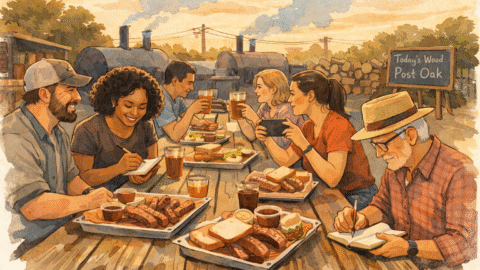
- Keep notes
- Take photos
- Track wood types, sauces, and styles
- Remember who they went with
- Document how the cook was done, not just how it tasted
They’re building personal BBQ journals — whether on paper, in their phone, or digitally.
Not to compete.
Not to publish rankings.
But to remember.
Instead of asking, “Is this a top 10 place?”
They’re asking, “Is this a place I want to remember?”
Taking Control of the BBQ Story
Personal tracking changes the relationship between fan and food.
You stop chasing consensus.
You start noticing patterns in your own preferences.
Maybe you realize you consistently love post oak over mesquite.
Maybe sausage matters more to you than brisket.
Maybe pitmaster interaction outweighs perfect sides.
Maybe character matters more than polish.
These insights don’t come from rankings.
They come from reflection.
And once you see them, you can’t unsee them.
Where BBQ Passport Fits In
This is where BBQ Passport fits naturally into the evolving culture.
Not as a replacement for rankings — but as a complement.
A place to:
- Track where you’ve been
- Log details that matter to you
- Record wood type, cook style, and smoke profile
- Attach photos and notes
- Build a living record of your BBQ journey
Instead of following the popular vote, you become the curator of your own experience.
Your top ten doesn’t have to match anyone else’s.
And that’s exactly the point.
A New Definition of “Best”
Maybe the future of BBQ culture isn’t about abandoning rankings.
Maybe it’s about contextualizing them.
Rankings can still guide discovery.
Personal journals preserve meaning.
In a world where great BBQ is everywhere, what stands out isn’t perfection — it’s connection.
The places that linger.
The meals that mattered.
The experiences you want to remember.
Final Thoughts: Memory Over Math
BBQ has always been personal.
We’re just getting better at acknowledging it.
Beyond lists, scores, and rankings, there’s a deeper layer of BBQ culture built on memory, preference, and feeling.
And the more we document our own journeys, the more we realize:
The best BBQ isn’t universal.
It’s individual.
Keep Learning
We Want to Hear From You
Do rankings still guide where you go, or are you starting to track your own BBQ experiences?
What details matter most to you when deciding whether a place sticks in your memory?
Share your thoughts in the comments — and if you haven’t already, start documenting your journey with BBQ Passport. Your BBQ story deserves to be written down.