
Great brisket does not end when it leaves the smoker
A lot of cooks treat brisket rest like dead time. The brisket is done, the fire is winding down, and now it is just sitting there wrapped while everybody gets hungry and starts asking when it will be ready.
That is the wrong way to think about it.
In Texas BBQ, the rest is not an afterthought. It is part of the cook. You can spend 10 to 14 hours building bark, managing fire, and chasing probe tenderness, then lose a chunk of that work by slicing too soon. A brisket that looked perfect on the pit can turn into a cutting-board puddle if it never had time to settle.
A proper brisket rest helps the meat relax, hold onto more moisture, and slice cleaner. It also gives the rendered fat and collagen time to settle into the texture you were trying to build all day.
If you want brisket that slices better, eats juicier, and feels more like the real deal, the rest matters.
Why resting brisket matters
When brisket cooks, heat pushes moisture and rendered fat toward the outside of the meat. At the same time, the muscle fibers tighten and the whole brisket is still carrying a lot of internal heat. If you slice into it right away, that moisture runs out onto the board instead of staying in the meat.
A good rest helps by allowing:
- Juices to redistribute more evenly
- Muscle fibers and proteins to relax
- Rendered fat to settle through the brisket
- Texture to stabilize for cleaner slicing
- Carryover heat to ease off before serving
That last part matters more than people think. Brisket does not stop cooking the second it leaves the smoker. If you do not manage the rest correctly, especially in a hot hold, you can keep pushing the meat past its sweet spot.
When to pull brisket from the smoker
A lot of people look for one magic number, but brisket does not really work that way.
Most briskets finish somewhere in the 200 to 205°F range, but internal temperature is only part of the story. Some are ready a little earlier. Some need to go slightly past that range. The real signal is tenderness.
Probe tender is the real finish line
When the brisket is ready, a probe, skewer, or thermometer should slide into the flat and point with very little resistance. You are looking for a softened, buttery feel, not a tight or pushy one.
That means:
- Do not pull brisket just because it hit 203°F
- Do not keep cooking it just because you expected a higher number
- Use temperature as a guide, but trust feel first
If the flat still feels tight, it probably needs more time, even if the number looks familiar.
The two stages of a proper brisket rest
A really good rest usually has two parts.
Stage 1: Cooldown before the hold
Right after the brisket comes off, it is still carrying a lot of internal heat. If you move a blazing-hot brisket straight into an insulated hold, it can continue cooking more than you want.
A short cooldown helps reduce carryover heat before the next stage.
Stage 2: Warm hold or slicing rest
Once the brisket cools slightly, you either hold it warm for a longer period or let it continue resting toward your slicing temperature. This is the stage that helps the brisket settle, hold moisture, and slice more cleanly.
Thinking in these two steps makes brisket resting much easier to manage.
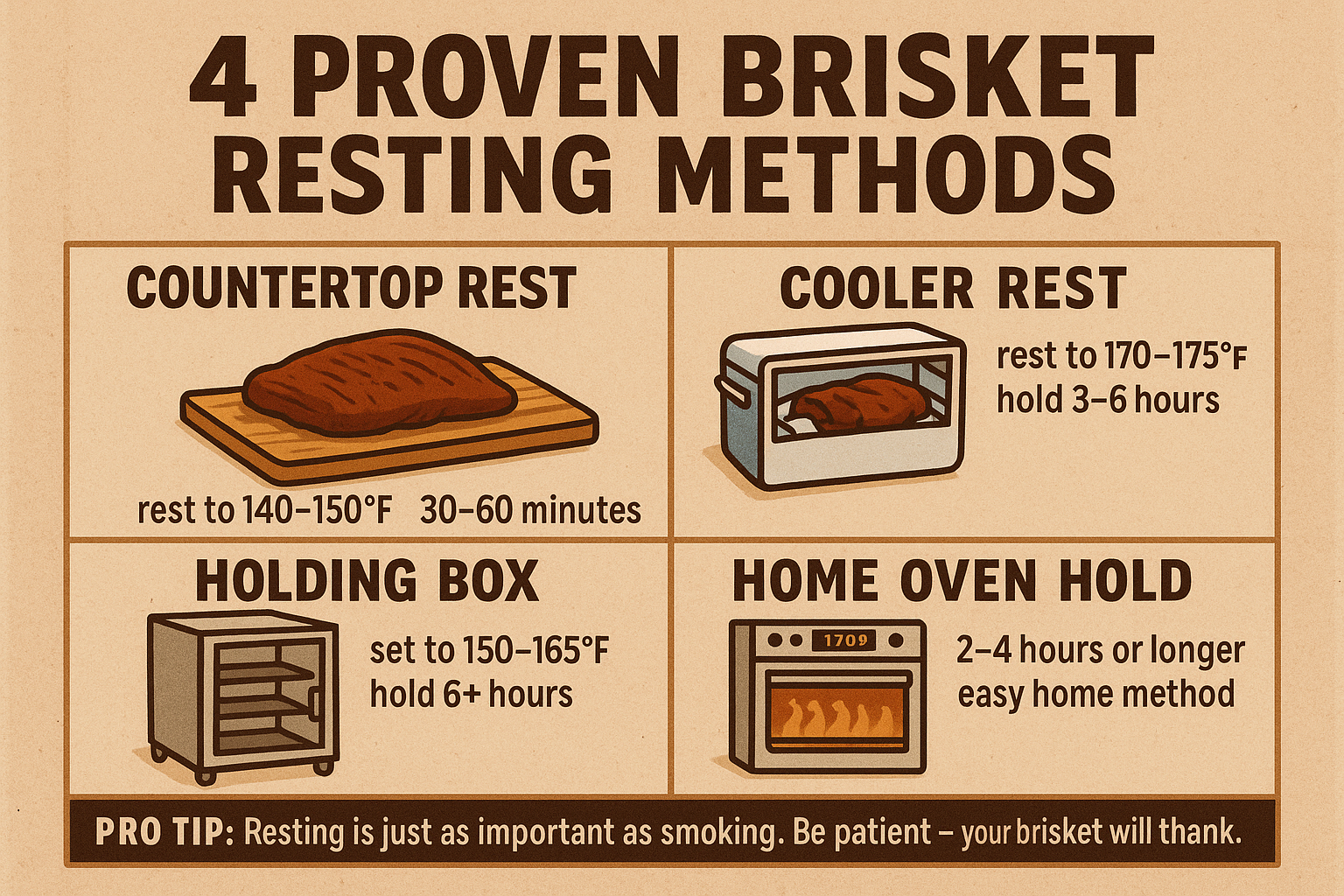
Countertop rest for a shorter hold
This works best when you are planning to slice and serve relatively soon.
When to use it
Use a countertop rest when:
- You are eating within about 1 hour
- The brisket only needs a shorter settling period
- You are not trying to hold it for several more hours
How to do it
- Leave the brisket wrapped
- Set it on a cutting board, sheet pan, or similar surface
- Let the internal temperature gradually come down from its finishing temperature
- Slice once it reaches a better serving window
Cooldown target
If the brisket comes off the smoker around 200 to 205°F, let it rest down into roughly the 145 to 155°F range before slicing.
Typical rest time
Plan on about 45 to 90 minutes, though larger briskets may take longer.
Why this range works
This gives the brisket time to stop pushing juices so aggressively while still staying warm enough to slice well.
Cooler rest for the classic home-cook method
This is one of the most popular brisket resting methods for a reason. It is simple, effective, and gives you a wider serving window.
When to use it
Use a cooler rest when:
- You need to hold brisket for a few hours
- Your brisket finishes early
- You want a more forgiving serving schedule
- You do not have a warming oven
How to do it
- Pull the brisket when it is probe tender
- Let it cool before the insulated hold
- Keep it wrapped
- Place it in a dry cooler
- Add clean towels around it for insulation
Cooldown target before cooler hold
If the brisket finishes around 200 to 205°F, let it cool down to about 170 to 175°F before placing it in the cooler.
Typical hold time
A cooler rest usually works well for about 2 to 6 hours, depending on brisket size, cooler quality, and how well the hold is managed.
Why this range works
Putting a brisket straight into a cooler at full finishing temperature can trap too much carryover heat and continue cooking the meat harder than you want. Bringing it down into the 170 to 175°F range helps protect the final texture.
Oven rest for one of the easiest home setups
For home cooks, this is often the most reliable and least stressful option.
When to use it
Use an oven hold when:
- You want more control than a cooler gives you
- Your oven can hold a low temperature steadily
- You want to keep the brisket warm for a few hours without guessing
How to do it
- Keep the brisket wrapped tightly
- Place it in a roasting pan or on a sheet pan with a lip
- Set the oven to a stable hold range, usually 150 to 170°F
- Hold until closer to serving time
Cooldown target before oven hold
If the brisket comes off around 200 to 205°F, let it cool to roughly 165 to 175°F before moving it into a low oven hold.
Typical hold time
This method often works well for 2 to 4 hours, and sometimes longer if the oven holds low and steady.
Why this range works
Because the oven is already providing controlled heat, you still want some carryover to bleed off first. Starting the oven hold around 165 to 175°F helps prevent the brisket from riding too hot for too long.
Warming cabinet or holding oven for the pro-style method
This is the cleanest method if you have access to dedicated holding equipment.
When to use it
Use a warming cabinet or holding oven when:
- You have access to restaurant-style hot-hold equipment
- You want the most controlled long rest
- You are feeding a group or working on a schedule
Hold range
A good holding range is usually 150 to 165°F.
Cooldown target before holding cabinet
If the brisket comes off the smoker around 200 to 205°F, let it cool to about 165 to 175°F before moving it into the holding cabinet.
Typical hold time
This method can usually hold brisket for 4 to 6 hours comfortably, and sometimes longer if the hold temperature stays controlled.
Why this range works
Even with pro-style holding gear, dropping a brisket directly into a warm environment while it is still extremely hot can push it further than you want. A short cooldown helps protect texture.
A simple brisket rest timeline
For most briskets, the rest works best in two parts: finish the cook, then manage the drop before the final slice.
A simple flow looks like this:
- Pull at probe tender, usually somewhere around 200 to 205°F
- Countertop slice soon: let it come down to about 145 to 155°F before slicing
- Cooler hold: let it fall to about 170 to 175°F before placing it in the cooler
- Oven or warming hold: let it fall to about 165 to 175°F before moving it into the hold
- Slice in the ideal window, usually around 140 to 150°F
This is the part a lot of brisket cooks miss. Resting is not just waiting. It is managing temperature on purpose.
What is the ideal slicing temperature for brisket?
This is where a lot of briskets are won or lost.
If you slice too hot, the juices run harder and the slices can feel looser than they should. If you let it go too cool, the fat starts tightening up and the texture loses some of that plush feel.
A very good slicing window is usually around 140 to 150°F.
In general:
- Above 160°F, brisket can still be too hot and loose, and juices may spill faster
- Around 140 to 150°F is often the sweet spot for clean slices and better moisture retention
- Below 135 to 140°F, fat can start firming up too much and the texture suffers
This is one reason the hold matters so much. It is not just about waiting longer. It is about bringing the brisket into a better slicing window.
How long should you rest brisket?
A lot of briskets improve with more rest than beginners expect.
At minimum, try to give it about 1 hour if you absolutely need to serve soon.
A more ideal range is often 2 to 4 hours, especially if you are using a controlled warm hold.
For many cooks, that longer rest is where brisket really starts to feel easier to slice and more settled on the tray.
Common brisket resting mistakes
Even a well-cooked brisket can lose quality if the rest is handled poorly.
Slicing too soon
This is the big one. If the brisket comes off and goes straight to the knife, you are skipping one of the most important parts of the process.
Moving straight into a cooler with no cooldown
This is one of the most common home-cook mistakes. Letting the brisket fall to around 170 to 175°F before the cooler helps reduce carryover overcooking.
Moving into an oven hold or warming cabinet too hot
Even controlled holds can keep brisket cooking harder than you want if it goes in straight off the smoker. Letting it cool to around 165 to 175°F first is the smarter move.
Holding it too hot for too long
A hot hold is useful. An overly hot hold can push brisket past where you wanted it and soften texture more than you intended.
Letting the brisket drop too low
If the brisket cools too far before slicing, the fat tightens and the eating quality drops off.
Using the wrong wrap for your goals
Foil holds heat very well, but it can soften bark faster. Butcher paper tends to preserve bark better, though every cook setup behaves a little differently.
Does resting brisket soften the bark?
Yes, it can, especially during a longer wrapped hold.
Any wrapped hold traps some moisture, and that moisture can soften the bark over time. That does not mean the rest is a mistake. It just means you are balancing bark texture against better slicing and internal moisture.
In most cases, a properly rested brisket with slightly softened bark is still better than a brisket sliced too early.
What if your brisket finishes early?
That is usually a good problem to have.
A brisket that finishes early can often benefit from a longer warm hold, as long as you manage the temperatures well. This is why a lot of cooks actually prefer finishing a little ahead of serving time instead of racing the clock at the end.
If your brisket is done early:
- Let it cool from finishing temp into the right hold range
- Move it into a controlled warm hold
- Monitor the internal temperature if possible
- Slice closer to serving time, not immediately
That extra buffer can make the whole day less stressful.
Brisket resting FAQ
How long should you rest brisket before slicing?
At least 1 hour is a good starting point, but many briskets benefit from a 2 to 4 hour rest, especially when held warm in a controlled way.
Can you rest brisket too long?
Yes. If it is held too hot for too long, it can continue cooking and lose texture. If it drops too low, the fat firms up and the eating quality suffers.
Should you rest brisket wrapped or unwrapped?
Most cooks rest brisket wrapped, especially for longer holds. Wrapped brisket holds heat better and usually rests more evenly.
What temperature should brisket be when slicing?
A great slicing window is often around 140 to 150°F.
Can you rest brisket in a cooler?
Yes. A cooler rest is one of the most popular home methods, but it works best if the brisket cools to around 170 to 175°F before going in.
Helpful gear for your cook
A few tools make brisket resting much easier:
- BBQ Blanket
- Roasting pan
- Instant-read thermometer
- Leave-in probe thermometer
- Slicing knife
- Aluminum foil or butcher paper
- Resting cooler
- Notebook or cook log for tracking mistakes and adjustments
Explore More
- The Ultimate Brisket Guide
- Brisket Stall Fix Guide
- Brisket Anatomy, Trimming & Slicing
- BBQ Math Guide
Final thoughts
A great brisket is not finished when it leaves the smoker. It is finished when it has rested properly, sliced cleanly, and landed on the board the way you intended.
That is why good brisket cooks stop treating the rest like a delay and start treating it like part of the craft.
Cook it until it is truly tender. Let it settle. Hold it wisely. Slice it in the right window.
That is how all those hours at the pit actually pay off.
We want to hear from you
How do you rest your brisket at home: countertop, cooler, oven, or something else?
Drop your method in the comments. It is always good to hear how other cooks handle the final stretch.